
 Liane Moriarty is one of those novelists whose work I eagerly anticipate. Her characters are always refreshingly human, quirky, and endearingly flawed. The plots of her books are unique, and each one is typically infused with a great mix of humor and poignancy. I can relate to many of the characters, always strong women navigating the difficult aspects of life. The Hypnotist’s Love Story, was one of two novels by Moriarty I hadn’t yet read. Now I have one final one, her newest, Nine Perfect Strangers. Her upcoming title, Apples Never Fall, is slated for release coming up in September of this year. That title screams of intriguing family drama, and I’m certainly here for it, because Moriarty does that quite well. This year I plan to tackle both and finish up the Moriarty library thus far.
Synopsis
Ellen O’Farrell is a single woman with a successful and fulfilling career as a hypnotherapist. Most things in her life are satisfying. Her mother is a bit eccentric, she’s never known her father, but she has a few close friends and she lives in the beloved house left to her by her grandparents. The only thing she truly lacks is a successful love life. So when she meets Patrick, a handsome widowed surveyor and single father, she starts to believe things could change for her. Until the night he tells her about Saskia, Patrick’s stalker. Instead of being upset by the news, Ellen finds herself fascinated by Saskia’s presence. She wants to know more about her, to understand her motivations. What she doesn’t realize is that she already knows Saskia, and things are about to get very interesting.
Review
Look, most of Moriarty’s books I absolutely love. Rich, intriguing characters are the driving force of her books. And each has its own unique plot, and her prose is quite charming. This one, however, I thought was lagging behind the rest. Merely glancing at other reviews and judging by the average rating on goodreads, I’m not alone in this being my least favorite of her novels. Ellen, while I thought she was a compelling character, just wasn’t as likeable as some of Moriarty’s other protagonists. Honestly, the most compelling character was Saskia. I enjoyed how we got the story from two different angles. Ellen’s portion was told in third person while Saskia’s portion was told in first person. We toggled back and forth fairly quickly between the two perspectives. I liked this as a device, and it was much easier to tell the two sections apart because of this narrative style. But I also think that’s why Saskia was a more compelling character. I thought Moriarty handled the psychological aspect of the stalker quite well. In her case, we are able to develop a kind of empathy for Saskia. She’s certainly been through a lot, and she has her reasons for having difficulty letting go. But the book makes it very clear the dividing line between compulsion and action on those compulsions. It highlights the sickness in a way that doesn’t undercut the damage that’s done to the target. At first I was a bit worried about this, because I felt so much on Saskia’s side. I had to keep reminding myself that she was the villain in the story. But Moriarty does circle back around on this, and I think she does so in an appropriate way.
Patrick was definitely my least favorite character. Don’t get me wrong, I like the fact that he’s portrayed as an average guy. His hair is thinning, he has issues with patience, and he procrastinates something fierce. He’s a great dad, and he has a good job and a nice family. Once he and Ellen truly become serious, however, there are a lot of red flags. Not just Saskia red flags but Patrick red flags. Honestly, his intense obsession with his dead wife would have been enough to send me packing. He talked about her constantly. Her presence was a ghost in the room everywhere they went. Keeping her memory alive for the sake of their son is one thing, but Patrick’s constant “Colleen this” and “Colleen that” and “Colleen did it this way” was just too much. My heart ached for Ellen every time he did this, and then I got angry with her for not telling him to knock it the hell off. You should not force your new partner to live in your old partner’s shadow, and the fact that Patrick was too obtuse to see that was infuriating. Even when he gave Ellen an explanation, it still didn’t sit well with me. No relationship is perfect, but theirs just had some major stumbling blocks right from the start.
Additionally, while this book held my attention, I found myself expecting more. I mean, save for one fairly difficult ordeal near the end of the novel, there really wasn’t much of a climax. It was a nice story, but it wasn’t really a great story. Trust me, I know Moriarty is capable of a great story. This is, at best, a decent book that will be forgotten fairly quickly, but I can definitely forgive Moriarty for that fact. I still maintain the woman hasn’t written a BAD book. Even superb writers put out average material now and then, and that’s ok. I will still be looking forward to the next one.
Overall, I give this one 3 stars.

 As you know, I always have two books going at once, one on audio and one in either hardback/paperback. Well, this week I’ve literally just finished one and am getting ready to pick up the next in line, so I’m only going to claim the one for my currently reading. On audio, I am almost finished (about 80%) with
  So, I probably shouldn’t be allowed to enter libraries. I showed up today to pick up a book I had on hold and walked out with 5. Oops. Suffice to say, I need to stay nose in a book before the due date of May 12th comes about. Can I do it with small children and a full time job and a house that’s bulging at the seams with useless crap that needs to be sorted through? Of course! *sarcasm alert* I can at least try, that’s all I’m promising.
  Moving on, the two I’m most excited to pick up include our next book club selection,
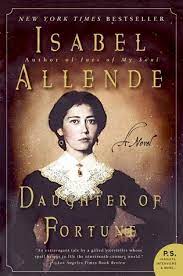 In 2020, I felt like I saw Isabel Allende popping up everywhere. She stays relevant by having a presence in pop culture, making guest appearances in major television shows like Jane the Virgin, in which she confronted her own real life trauma for the purpose of helping a character deal with her own. It was an incredibly moving and pivotal moment in the show that helped illustrate literature’s important place in helping us make sense of the incomprehensible tragedies of life. As an avid reader, I find it strange that I made it to the age of 36 without having picked up one of her books, so I added her to my TBR ASAP list.
  Daughter of Fortune follows Eliza Sommers, a young Chilean woman left on the doorstep of Jeremy and Rose Sommers, a brother and sister who reside in the British colony of Valparaiso in Chile. She’s raised by Rose with the help of Mama Fresia, the native Chilean cook who helps out at the Sommers estate. Eliza grows up in these dichotomous worlds, both a lady of culture and style and one of resourcefulness with a lust for adventure and knowledge. The novel spans time from the early 19th century in Valparaiso through the mid-1800’s at the height of the California Gold Rush that sees our young heroine set off for California by herself in search of her lover, the idealistic Joaquin Andieta. The novel finds Eliza facing harrowing obstacles, instantly forcing her to confront the bounds of her own perseverance. By her side on her quest is a Chinese healer, Tao Chi’en, a grieving sailor who was duped into a sailing contract by the captain of a ship sailing for Chile despite his successful career as a zhong yi, or a Chinese physician. Though they both are in search of a specific kind of deliverance, they will each discover their destinies are not what they had originally expected.
 Allende is considered a leading author in the genre of magical realism. I would place this book more into the category of straight historical fiction. Sure, there’s a bit of the fantastical here. An example would be the presence of Tao Chi’en’s dead wife, a ghostly presence that follows him and provides counsel from time to time. However, it’s purely up to reader interpretation as to whether or not Lin is actually present or is just a figment of Tao’s imagination meant to help him cope with the stress of his new life. Overall, this novel presents a realistic look at the difficulties and hardships of the North American frontier as immigrants from all over the globe converged on California in pursuit of the all consuming obsession that was gold. Allende is not overly verbose. She gets to the point. Her prose is as raw as the California landscape in the 1840’s, quite effortlessly beautiful when warranted, though more than a little harsh. This was a time that either saw people flourish or become consumed by the ill-tempered fury of the times. People either relented under the pressure of pain, prejudice, lust or vengeance, or they became stronger, more compassionate, more willing to come to the aid of their fellow humans, if they survived at all.
  At first glance, I could tell this book was right up my alley. Badass women, trips down deep back corridors of the darkened streets of historic London, and a bit of a mystery to sweeten the pot. As for the cover, I adore the blend of colors, the font, the aura of mystery. I’m intrigued by stories with dual timelines, though this can become tricky if one is more well executed than the other, so I’m generally wary. It didn’t hurt that this book is a very short read, as I’m woefully behind on my reading goal.
 I’ve always loved classics, but I gravitate more toward 19th century British lit, and authors like Vonnegut often have been relegated to the “I know I should read it and I’ll get to it eventually” pile. We all have one of those piles, correct? That’s why it’s helpful in book club when every now and then a member chooses one of these classics. Such was the situation with Slaughterhouse-Five. And I’m really glad to have finally picked this up. This is a very personal novel for Vonnegut. In 1943, Vonnegut enlisted in the army. He was sent to fight in the European campaign during WWII where he was captured during the Battle of the Bulge. He was sent to Dresden and was, in fact, in a meat locker during the fire bombing of Dresden by Allied forces in February 1945.

 I’ll start by saying this book was a fabulous book club pick. There’s so much to analyze and to discuss, and I actually found myself growing to admire Vonnegut even more after discussing the book with the other members of Read Between the Wines. Also, I knew this book was on the banned books list, which basically gives me extra incentive to read it. In the Mentalfloss article, “
 If we were to break this down, it becomes fairly obvious that the creation of the Tralfamadorians within Pilgrim’s mind are a coping mechanism. They are a way to explain and process that which is unthinkable. His jumping through time is his way of placing himself within a happier existence, convincing himself that as long as he has been contented and will be again, the present agony doesn’t matter. And the deaths of his fellow soldiers as well as the strangers in Dresden who were all blinked from existence in a raging fireball don’t matter because a being can’t actually die in a four-dimensional reality in which all points in time exist concurrently with one another. It’s both comforting and simultaneously tragic. In a prior life of my own I may have gone down the research rabbit-hole and devoured page upon page of literary analysis from people much smarter than myself. As it is, I’m merely content to regurgitate my gut reactions. I’ve seen people classify this book as science fiction. I would completely disagree with that. Despite the presence of the Tralfamadorians, I don’t believe we are meant to believe they actually exist.
  In my opinion, this novel is an excellent portrait of the living casualties of war. Those who return home haunted by the ghosts of the past. Really, this is a flawless portrait of PTSD. According to the
  If you could sum this book up in one line, it would probably be: Idiots are people too. As usual, Backman presents us with startling truths in a way that also brings a smile to our faces. His writing is always superb, his characters refreshingly quirky, and his stories the kind of heartfelt fare to which you can’t help but return. It’s amazing to me that Backman’s first novel came out in 2012 and he’s since consistently been able to release incredible books on a regular basis.
  I don’t think there’s anything about this book that isn’t charming. Once again Backman has exhibited that he has a very intimate grasp of what it means to be human. He sees people, inside and out, with all their flaws and idiosyncrasies. And he makes that complete package beautiful and understandable. So much of this book is relatable simply because we’re all people. And, honestly, we’re all idiots. To someone, anyway, you are an idiot. And to you, they are an idiot. But what would happen if you were forced to really connect with that person on a level that we never grant to strangers? That’s the question that this book poses. And if you really take time to think about it, you start to see people differently. Deep down we’re all battling so many of the same things. Whether it be crippling anxieties, feelings of inadequacy, unrealistic expectations, abject loneliness, we all have our inner demons that stop us from feeling quite right about where we are in life. These feelings have no regard for how much money or status one has. We’ve all looked in a mirror or listened to our own voices played back to us, cringed, and thought, “why do I have to be this way?” Frankly, if you haven’t had these experiences, you’re probably dreadful to be around.

 In Code of the Hills, Elsie is tasked with prosecuting a particularly difficult child rape and incest case involving a father and his three daughters. In rural McCown County, a fictional county in Missouri that Allen has created for her series, people don’t discuss matters such as abuse or neglect, and they especially don’t discuss incest. Members of the police department and the prosecutor’s office, however, know that such evils roil and seethe beneath the surface of the idyllic facade of this small community. Beautiful rural countryside hides an awful truth. Poverty and drug use are rampant, and mothers often can’t or won’t protect their children from the men in the home preying on them, as interfering could get them hurt or killed. Because you really can’t protect you’re children if you’re dead. Elsie is tasked with proving, beyond a reasonable doubt, that one such father should be put behind bars for the sake of his family’s safety. But as she’s seen in past cases, this is often easier said than done. Elsie will uncover an even uglier side of her town as her very own life is threatened by the supporters of the assailant, people who will stop at nothing to silence women like Elsie. After all, the Bible says a woman shall remain silent in the presence of a man, and there’s nothing more threatening to these people than a woman in a pantsuit with an opinion and a degree to back it up.
  A Librarian and Her Books