
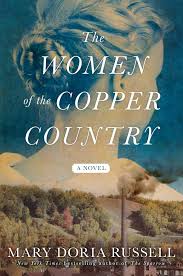
 No matter your taste in books, I could probably recommend a Mary Doria Russell book to you that you would love. The Sparrow is my favorite science fiction book, but this badass woman with the fiercest intellect around can write just about anything. Her historical fiction is nearly unmatched in depth of research and attention to detail. Once again, Russell has crafted a gritty and memorable tribute to real-life heroes who walked this Earth. The women and men in this book made it possible for the workers of today to fight for fairness and actually win.
Synopsis
 The Women of the Copper Country is a fictionalized account of the story of Anna Klobuchar Clements, otherwise known as Big Annie. In 1913, Annie Clements earned the title of “America’s Joan of Arc” for her role in leading a strike against a large and powerful copper mining company in Michigan, Calumet & Hecla. The novel pits Annie up against the villainous James MacNaughton, her nemesis in both this fictional work and in the historical record. Russell’s novel is a very raw and real portrayal of the plight of the striking worker in the early 1900’s, as well as that of their wives and mothers who fought to keep food on the table. Most importantly, it’s the rarely told tribute to the women of the labor movement, those who risked their own health and safety to ensure their sons and grandsons wouldn’t befall the same fate as their fathers and husbands.
Review
In every case, the strength of one of Russell’s works of historical fiction is her meticulous research. While much of Annie’s life on the page is fictionalized, Russell offers us a visceral and intimate glimpse into the life of the real Annie. She perfectly captures her resolve, integrity, and her difficult moments of self-doubt and turmoil. Many characters are either composites of real individuals or are entirely fictionalized, but their sole purpose is to provide a foundation for us to better understand Annie and her impact on the labor movement, as well as the impact of all women, whose role in progressive social change throughout history is often drastically understated, if not ignored completely.
One of the most interesting aspects of this novel is Annie’s tumultuous relationship with her husband, Joe Clements, an abusive drunk who doesn’t support either Annie’s work as a union leader or even the strike itself. Annie is torn between this urge to remain loyal to her husband as society dictates or to remain loyal to her personal convictions and moral obligations. Would we be where we are today if it weren’t for women brave enough to tell their short-sighted husbands to shove their opinions where the sun doesn’t shine? That’s a resounding no. Thankfully, there are enough fabulous and brave men in this book that one doesn’t have to worry about it seeming “anti-men,” which some people seem to worry about, and usually for silly reasons.
This novel also contains some beautiful cameos of other real heroes of the labor movement, including Mary Harris “Mother” Jones, whose visit to Calumet in support of the strike really did occur in August of 1913. Jones, while featured very shortly in The Women of the Copper Country, is one of the more memorable characters of the book, her fiery and plucky spirit reinvigorating a movement that has fallen on hard times and hangs on the precipice of failure. Like the strikers, readers find themselves wanting more of her but having to trudge on alone, encouraged by the strength that lingers in her wake.
More than anything, this work of historical fiction is fiercely and depressingly relevant in today’s political climate. It is Russell’s most politically charged work to date, and it comes at a very good time. We find ourselves at the close of a pandemic, when many people have grown weary of busting their asses for pennies for employers who neither care about their physical or mental well-being nor whether their wages can even cover a month’s rent. Most have forgotten or scoff at the sacrifices of the ancestors of the labor movement. The word union is still spat out like a curse word by those whose forbearers poured more dirt on the bodies of the miners who worked for mere pennies until unsafe conditions brought about their early deaths, as well as those of their fathers and grandfathers. Same shit, different decade.
These same people feel history shouldn’t actually be taught in our schools, because it will show our children that history is full of ugliness, greed, and prejudice. You can’t stop yourself from repeating a mistake you don’t remember, and a society that covers up its ills will repeat them over and over again with different victims. The cycle will merely continue forever. Censorship and suppression only bring more trauma, so if a school board tells you not to put a book in your child’s hands go out and buy a damn copy because that’s a book they should read. With that in mind, if you Virginia folk want to see what all the fuss is about, Beloved by Toni Morrison is on sale on Amazon, and everyone should read it. Get your copy here. For a comprehensive list of the books some people say you shouldn’t read, see the American Library Association’s Office for Intellectual Freedom’s website. Every one of them has something to teach you.
I realize I haven’t focused as much on the actual book as I usually do, but this is an extremely important read about a unique and specific moment in America’s storied past. It has the beautiful, effortless prose you’d expect from a Mary Doria Russell novel and characters who will leave their mark on you. Some books are good but you forget them pretty soon after putting them down. You won’t forget this authentic story, and you sure as hell won’t forget Big Annie, the 6’1″ angel with her flag held high and her voice raised above the crowd. If you are looking for a great work of historical fiction that is of the utmost relevance in today’s age, look no further than The Women of the Copper Country.
- “Anna Clemenc” Upper Peninsula Wiki. https://michigansup.fandom.com/wiki/Anna_Clemenc Accessed Oct 29, 2021.
- “Labor’s Patron Saint & Her Words of Wisdom.” The Laborist. https://labor.ist/labors-patron-saint-her-words-of-wisdom/ May 19, 2020.
Published August 6, 2019 by Atria Books. ISBN 1982109580. Hardcover. 352 pages.

 Since I have not made much progress at all with hard copy books, I’m still working my way through Apples Never Fall by Liane Moriarty. It’s very engaging, and I wish I’d had more time to devote to it lately, especially since my library copy is due tomorrow. Eek.
  On audio, I have just started The Song of Achilles by Madeline Miller, a book I’ve been looking forward to picking up for a really long time, ever since I read Miller’s Circe, which I positively adored. I’m really enjoying both of these current reads so far.
  Last week I went to a similar event with Grady Hendrix. Both men were extremely pleasant, gracious, and quite funny despite writing some seriously disturbing stuff. I’m thrilled to have picked up copies of their books and gotten to chat with them a bit while they signed my copies. My review for Jones’ book should be up in the next week, as I’ve tacked it onto the end of my long list of reviews to write.
  What will I read next?
  I have just finished reading the audiobook version of Unf*ck Yourself: Get Out of Your Head and Into Your Life by Gary John Bishop. I will likely write a pretty short review of this one today. It wasn’t exaclty earth-shattering, but it was useful for its intended purpose and I think it was quite a big dose of reality that I needed this week. The other book I finished I will post a more detailed review of.
  It’s Tom Sawyer by Mark Twain. To be honest, though a classic, I don’t find Twain as charming as I used to. Maybe it’s my current mood. Not sure, but I’m still going to finish it for the reading challenge.
  If you are a lover of historical fiction, commit the name Nathan Harris to memory, because you will be hearing from him again. Harris is an alumnus of the Michener Center for Writers out of The University of Texas at Austin. While there, Harris spent most of his time focusing on The Sweetness of Water. Let’s face it, novels of the Civil War are common, but only an expert wordsmith can create something so unique and refreshing in a genre flooded with content as to speak to every reader in a deeply personal way. This is surely one of these books.
 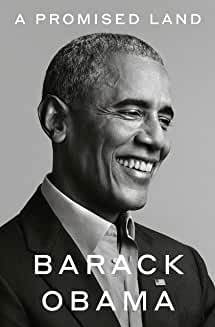 A Promised Land is the Presidential memoir of the 44th President of the United States, Barack Obama. Obama was a positively historic President for the US, as he was the first black President to serve as commander in chief in a country whose history is seething with racial strife. His election was a momentous occasion for millions of Americans, and it was especially important for young people of color growing up in a country that previously felt like such a position was out of their reach. He was and still is an extremely polarizing figure, either adored or demonized depending upon which side of the political divide one falls. In reality, any human individual who has ever sat in the seat in which he sat contains flaws, and he is no different. No President has ever made perfect decisions, just as no other flesh and blood person has ever made perfect decisions. The difference is that the President makes decisions in front of the entire nation and the entire world and will be forever judged by those decisions. And will also have to deal with a whole lot of malarkey flung their way, which should just be ignored, as he deftly demonstrates in this book.
 Ten-year-old Ruby Trick lives in the small seaside village of Limeburn in Devon the United Kingdom. She adores her father, the unfortunate John Trick, an out of work and down on his luck lover of all things cowboy, and practically detests her mother, Alison, a woman we readers can quickly glean is much more complicated than Ruby imagines. A masked assailant begins to terrorize the women of Limeburn and his antics quickly turn deadly. When John takes Ruby along on his “posse” to track down the killer, Ruby finds herself facing potentially deadly consequences for herself and her family.
 I am going to start the same book I planned before, Apples of Stone by Philip Marsh. I saw his brother yesterday at work and verified I would be picking it up soon, so I am really truly committed now. Until next time, happy reading! Hopefully I’ll have more to share next week.
  This is an incredibly different book than the last Hoover novel I read, It Ends With Us. There are some similarities. Again with the odd naming conventions, though I do rather like the name Verity Crawford. There is also a very intense undercurrent of abuse, though in this case it is pretty intense child abuse versus the spousal abuse from the first, so be warned. Otherwise, whereas It Ends With Us is a pretty straightforward plot, this one is twisty and intriguing with more than a few curve balls.
