 Still working through my reviews from 2021, I come to the Biography for the reading challenge. This is an interesting one in that, while it does surround the life of Mary Shelley, it puts a particular focus on the influences surrounding her creation of her most famous work, Frankenstein: Or the Modern Prometheus. In doing so, Montillo discusses the lives and work of notable scientists and doctors who were experimenting with electricity and reanimation of cadavers. Many people see Victor Frankenstein as a fictional character without realizing he was the embodiment of the vision of greatness in the minds of many a real man. He achieved in fiction what the most ambitious scientific dreamers were attempting, reanimating the dead.
This introduction of a rather odd period of scientific progress does two things for the book. It introduces a moderate amount of “Ewwwww” but also a little humor in a pretty twisted and sick way. I mean, science is a trial and error kind of thing. Will you successfully reanimate a body and bring a man back to life or will his head explode and splatter the rich people in the front row? NOBODY KNOWS!
There are serious overtones to this book. Number one, it brings to light some issues with the criminal justice system during this time period. Many of the bodies acquired by scientists for their experiments came straight from the gallows to the lab. This was a brutal time in which civil liberties weren’t at all considered. Men, sometimes mere boys, were hanged for crimes that would today receive not much more than a slap on the wrist. Often they were innocent. If not from there, they came through the lucrative and mafia-esque criminal enterprise of grave robbing. There was a very fine line separating the realm of science and the seedier shadow world of European society.
All of this historical scientific information was juxtaposed with the details of Mary Shelley’s life, which was far from a happy one. It was one full of loss and strife and containing blatant skepticism from male members of the scholarly community for her intellect and literary achievements. She was ridiculed and rejected by polite society for her bohemian lifestyle, just as her own mother was in her day. Sure, Frankenstein is a marvel of achievement in science fiction, but it’s also a novel rich with emotional depth. Scholars often only focus on the predominantly male aspects in the text, the creation through science, intellectual achievement, a piecing together of dead flesh and reanimation to something with breath and vitality. They often ignore the presence of the female, natural creation through birth, loss of the self, of the humanity of a nameless creature who will never experience love or the nurturing touch of a parent. I in no way mean to imply these two spheres exist solely within the realms of the two sexes, but merely that the scholarly thought at the time distinguished them as such.
Mary Shelley would give birth to five children. She would bury four of them and lose another to miscarriage that almost claimed her life. We’d be remiss to ignore the fact that Mary Shelley’s grief is a haunting presence in this story. Her nameless creature is a reflection of the nameless child whose birth and death preceded the writing, that the rejection of the creature is a manifestation of the motherly guilt that comes with not being able to follow your baby into the frightening world of the unknown. This guilt is totally unjustified, but any mother who has lost a child will tell you its presence is felt just the same.
When we focus on the creature as being a monster, we see him as a villain. I’ve never read the creature as a villain, but rather a lonely and desperate individual whose experiences with nothing but rejection pushed him further into despair. The torment Victor endures after rejecting his creation is a manifestation of the torment felt by a parent who loses a child. In many ways, it’s a novel about mental health, both that of the creature and the creator. It’s about loss and the fundamental change that a person experiences when living through loss so deep it alters every aspect of the self. This is something Mary Shelley understood far too intimately, and Montillo does delve into the depression that afflicted Mary Shelley’s years following the publication of her novel. This depression that was magnified every time she experienced the loss of yet another child.
Writing her masterpiece was a catharsis that could only have come from her own mind, despite the prevailing thought at the time that a woman couldn’t have penned such a work. It was originally published anonymously, nameless authorship in homage to the nameless tragic hero of its text. Many would assume her husband, Percy, was responsible for its writing. Well, the joke is on them, because the average person probably couldn’t name even one thing a bunch of those famous men of the time wrote, but literally everyone is familiar with the name Frankenstein in some capacity, even if they only know that stupid green Halloween caricature that bears no comparison to Mary Shelley’s tragic hero. Her revolutionary work was the perfect blend of the masculine and feminine spheres of society, thus proving that the human self is not complete without the merger of the two. Not to mention, she created a whole new damn genre. No man would be publishing science fiction today had a woman not paved the way for him. Take that, you sexist assholes of the 1800’s.
Ok, wow… I totally stopped talking about the book I’m reviewing and moved to Mary Shelley, because she’s amazing. Frankly, I wish Montillo had discussed her a lot more in this book and focused a lot less on her relationships with the men, like Percy and Lord Byron. Given the fact that we got very little information about Shelley’s writing process, the two parts seemed a bit disjointed. This is largely because much of the theory behind it is conjecture on the part of the author merely because it makes sense. Of course Mary Shelley was influenced by the work of scientists of the time, because her masterpiece reflects their prevailing thoughts and mirrors the experimentation that permeated the scientific community. However, from what I could tell there isn’t really a whole lot that we have to actually tie those two things together besides that conjecture. Perhaps there’s just not much in the written record showing that Mary Shelley actually communicated with or studied the work of scientists. In that respect this book felt a little bit like ping-ponging back and forth between the science stuff and the biography stuff and they didn’t really feel very connected unless you did some mental stretching.
This is an extremely fascinating concept and a very unique perspective on Mary Shelley’s life. For anyone with an interest in Mary Shelley and her most famous literary duo, this is a great start even if it could have been a bit more well executed. The research concerning the science at the time seemed a lot more thorough than the research into Shelley. The things I discussed here in my review were merely alluded to by Montillo and not actually discussed, which I feel was a mistake. Frankenstein is not just a novel about science, it’s a novel about what it means to be human. Overall, 3 stars for this one. Enjoyable but missed the mark in certain ways.
Published February 4, 2013 by William Morrow. Paperback published October 22, 2013. ISBN 006202583X. 336 pages.

 I thought about posting merely a series of GIFs exhibiting various emotions as representative of my thoughts on this book. I guess I’ll give you a little bit more than that. But, for the record, my search for said GIFs would include such search terms as WTF, OMG, and holy fuckballs, Batman.
  Let me start this review by stating I love what Madeline Miller does. There’s a relatively new push in the entertainment industry to take classic stories of good versus evil, hero versus villain, and add layers of complexity where there once was a simple formula of black and white. Not to say this is a completely new phenomenon, but we’re seeing it pop up on a much larger scale in recent years. We’ve seen this in the Disney universe with movies like
  With Achilles, anyone who isn’t familiar with his name has been living under a very large rock. He’s given his own hero tale within the Greek myths, a tale which has spawned numerous appearances for him in novel, television and film. Most notably, Brad Pitt portrayed the great hero in the 2004 film,
  I would say the power of a book lies in whether or not it delivers to a reader a simple story or a true reading experience. I’m not necessarily saying one or the other is a good or a bad thing. You can have a great story that is pretty unforgettable, but that story doesn’t perhaps bring with it all the aspects of a full reading experience. It’s sort of the difference between going on a vacation by taking an air conditioned tour bus and slapping on hiking boots and footing it across the countryside. The first is easy and enjoyable. The second is difficult but personally fulfilling in a way you couldn’t get from the first. That begs the question, what does it take to live an experience? Just think of a time in your life that you had a mind bending life altering experience? What did that feel like? Maybe it felt good, in a way. Or, at least, the end of that experience brought some clarity. It changed you, altered your perception of the world or of yourself. But during that experience you probably ran through a wide range of emotions. Amusement, frustration, fear, confusion, sadness, exhaustion, to name a few. Or maybe you had absolutely no fucking clue what you’d taken away from it. Not only is that completely valid, but it’s pretty much the entirety of human existence wrapped into one analogy. Do any of us really know what the hell is going on or why we are here? No, we don’t.
  Well, it’s positively shameful that my last review was posted in February. Frankly, I’m so far behind on reviews not sure how I will catch up, but my next few may be pretty short. I have still been reading, but the overwhelming nature of life lately has left me both without time or motivation to put my thoughts in writing. Frankly, that’s not really fair to the books or the authors who took the time to put pen to paper with their own thoughts. But that’s the nature of life, as well.
 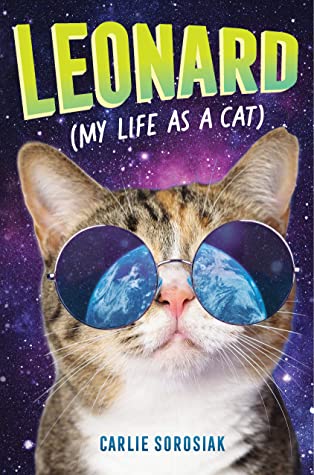 My last review for The Bell Jar was super heavy, so I thought I’d follow it up with something super fun. My daughter, who is 7, is reading well above her grade level so we’ve moved on to chapter books. On one trip to the library, we stumbled across this one. She is feline obsessed, so naturally we had to pick it up even it was a bit mature still for her as a middle grade book. Look at that cover! How could you not want to know what lay within the pages? So I read a little of it to her each night, and I think I liked it even better than she did.
  Every now and then, there’s a story behind the story. Fiction is a veil cast over a haunting reality. Many authors’ own lives were as intriguing and sometimes heartbreaking as the tales they wove into the tapestry of literary canon. Those like Kurt Vonnegut, as discussed in
  Still catching up on my 2021 reviews, so bear with me. This is one I finished back in November, I think. Yikes. Not long before that I read my first Beth O’Leary novel, The Flatshare. I positively loved its charm and wit. The characters were lovable. I expected the same here but really found it lacking, unfortunately. It is a short read, and it’s romantic and well-written in O’Leary’s signature style. In this case, however, neither the story nor the characters kept my attention.
  This book was quite fittingly the October book pick for Read Between the Wines. Let’s face it, this is a classic horror novel. Though, if I’m being honest, I hear a lot more about the movie than I do the book. I feel like there’s a reason for that. Don’t get me wrong, there’s only one person to thank for what was, at the time, the most frightening thing anyone had ever seen. This story, loosely inspired by true events (a fact I find utterly terrifying) is the brain child of none other than Blatty. I’ve heard numerous people of that generation say that The Exorcist haunted both their waking and sleeping hours after having seen it. Perhaps it’s that hype. Perhaps it’s the fact that I expected so much that left me a little wanting upon finishing this book. So let’s get into it, shall we?
  A Librarian and Her Books