A Librarian and Her Books
Home | About | Archives
We Have Always Been Here by Lena Nguyen – a Book Review
October 6, 2025 10:21 pm
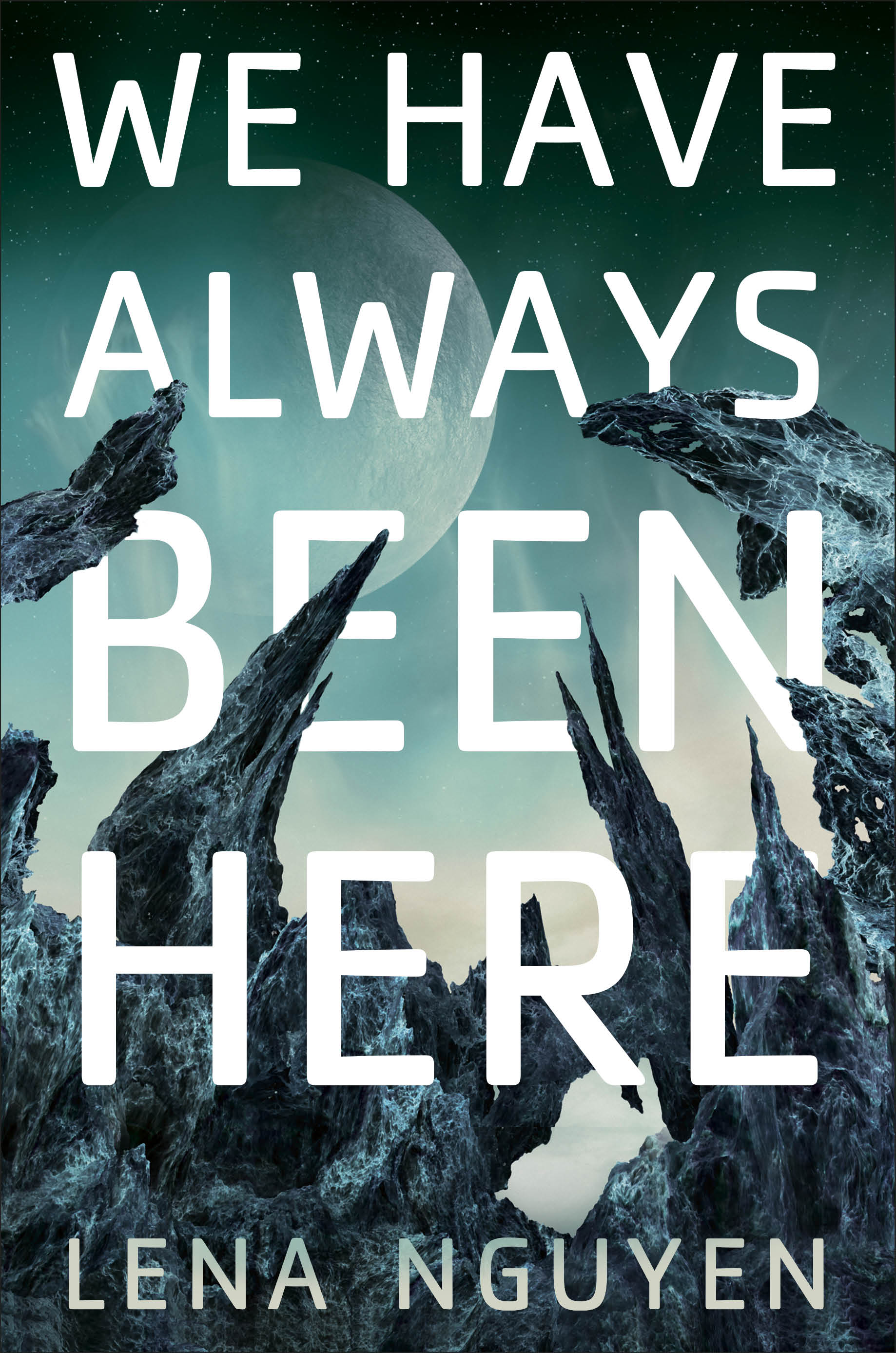 If you’ve followed my blog a while, you may have noticed I don’t read a lot of science fiction. I’m far from an aficionado, but I do have some favorites in the genre. Andy Weir comes to mind as someone who’s blown me away with his tightly-crafted and scientifically-convincing works. I love when someone can lay out for me a scientific future that really makes sense. It feels possible and concrete. It doesn’t really take much, as I would be rubbish at explaining the mechanics of anything involving space or space travel. I find it fascinating but know nothing. That’s sort of why I added galactic science fiction to my reading challenge this year, hoping to maybe find my next Project Hail Mary-esque obsession.
We Have Always Been Here is the debut novel of writer and game developer, Lena Nguyen. It’s an ambitious narrative that follows psychologist Grace Park, a very distracting name for me, as there’s an actress named Grace Park. Naturally, I pictured book Grace as on-screen Grace, so here you go:
Dr. Park has an awkward relationship with her colleagues aboard the Deucalion, a survey ship sent out on a journey to explore the planet Eos, a potential site for human colonization. Grace’s job is to monitor the psychological well-being of the thirteen other crew members on board. Unfortunately, Grace doesn’t really do people very well. She’s not your average person and can come across as a bit detached, cold, and robotic to her peers. The others don’t seem to like her either, treating her with either antipathy or downright hostility. She feels a greater connection with the androids aboard the ship and doesn’t quite understand her fellow humans, which seems a little odd as her job is literally to study people and understand the inner-workings of their minds. Sort of seems like there was a missed opportunity to have Park’s assignment on board to be related to the care of the androids.
I get what Nguyen is trying to convey with the character of Grace, and I think it’s an interesting device placing her as a buffer between the human world and the android world. At times, however, she does come across as very unlikable. We actually see her at her most human with her interactions with the androids, both those on the ship and in flashbacks we get from Grace’s childhood. Her most rewarding and loving relationship was with an android protector, Glenn. He was more of a support system to her than the Uncle who served in place of absent parents. Getting this backstory really helps us understand Grace, so I appreciated that very much. Still, considering her lack of comfort in the human world, her choice to pursue psychology and work with people is a perplexing one. That’s just one of the frustrating and confusing aspects of this novel.
The science Nguyen is trying to present with this novel is a very ambitious undertaking, and I can’t say that it was done with expert precision. The later half of the novel feels quite contrived, almost convenient, and this all follows a fairly formulaic and overly-long first half. People going a bit crazy aboard a ship floating out in space is hardly a new concept and, while Nguyen did infuse a very unique twist on it nearing the conclusion, it was a little too chaotic to pack the punch she intended.
As far as the mystery/thriller aspect of this is concerned, I didn’t really find myself surprised by anything. Considering the length of the novel, I was relieved to be done. Overall, there was a lot here I could appreciate, but I think Nguyen tried to do too much too fast and should have slowed down and put more emphasis on research before trying to lay out something this technical.
Published July 6, 2021 by DAW Books. ISBN 9780756417291. Hardcover. 355 pages.
Posted by Amy @ A Librarian and Her Books
Categories: Science Fiction, speculative fiction, thriller, Uncategorized
Tags: Artificial Intelligence, book review, books, fiction, reading, Science Fiction, space travel
« Older Newer »
Leave a Reply
Mobile Site | Full Site
Get a free blog at WordPress.com Theme: WordPress Mobile Edition by Alex King.