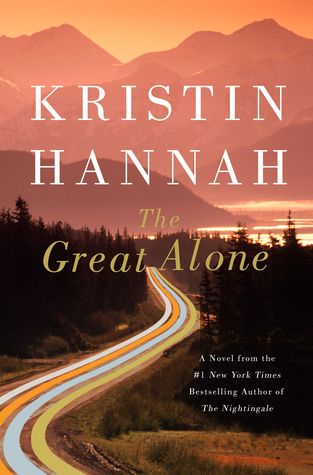
 Unfortunately this will be the last of my 2023 backlog that I’m going to fully review. All of the others I’m just posting quick little goodreads review and starting fresh in 2024 with the blog. I got way too far behind. But this book deserves the full treatment, because Kristin Hannah has an absolute gift. She’s an incredibly versatile author, and though her books often vary in subject matter and time period, they always contain the same elements that elevate them above many other books written by her contemporaries. They manage to contain all the sheer beauty and brutality of life in such an authentic way. In The Great Alone, she allows the setting of a remote and unforgiving corner of the Alaskan wilderness to perfectly encapsulate the tone of this story. Life is brutal. Life is beautiful. Life will gut you and leave you breathless with ecstatic wonder.
Synopsis (from Goodreads)
Ernt Allbright, a former POW, comes home from the Vietnam war a changed and volatile man. When he loses yet another job, he makes an impulsive decision: he will move his family north, to Alaska, where they will live off the grid in America’s last true frontier.
Thirteen-year-old Leni, a girl coming of age in a tumultuous time, caught in the riptide of her parents’ passionate, stormy relationship, dares to hope that a new land will lead to a better future for her family. She is desperate for a place to belong. Her mother, Cora, will do anything and go anywhere for the man she loves, even if it means following him into the unknown.
At first, Alaska seems to be the answer to their prayers. In a wild, remote corner of the state, they find a fiercely independent community of strong men and even stronger women. The long, sunlit days and the generosity of the locals make up for the Allbrights’ lack of preparation and dwindling resources.
But as winter approaches and darkness descends on Alaska, Ernt’s fragile mental state deteriorates and the family begins to fracture. Soon the perils outside pale in comparison to threats from within. In their small cabin, covered in snow, blanketed in eighteen hours of night, Leni and her mother learn the terrible truth: they are on their own. In the wild, there is no one to save them but themselves.
Review
Truly great books do not leave the reader feeling sheer joy. You don’t come away with one emotion. Sometimes you come away feeling this mixture of anger, frustration, elation, heartbreak and exhaustion that makes no sense but feels like exactly what you need. We all know what it’s like to be Leni, in some fundamental human way. We’ve felt the desire to belong, and we’ve come to know that it’s possible to love and hate in equal measure, to fear that which you also desperately need, whatever that may be. And we all know what it’s like to feel the frustration of wanting to fix everything but not knowing how. The flaws of the people Leni loves hold her captive, and try as she might she will never change them. The only thing she can do is learn from their mistakes and grow in a way in which they all seem incapable.
I tried not to hate Leni’s father. I tried to understand how his awful experiences in life had twisted him into someone his family couldn’t recognize, but I’m pretty sure I failed. Let’s face it, many people (too many) have awful traumatic experiences surrounding war and don’t come out as abusive and dangerous individuals. You have to pile all that trauma on top of an already shitty world outlook, a giant dose of misogyny and racism and then you get a man like Leni’s dad. Surviving a war has nothing to do with strength. War doesn’t choose who gets to live and die based on who is and who isn’t a good person. If your weakness is powerful enough, you will still let it destroy you and everyone and everything you love. What I will say is his character is perfectly believable and that’s a very sad reality. There are a lot of people out there suffering under a pain they won’t face in a healthy or meaningful way. They’ll use it as a way to drag others down with them. Hannah found the true survivor’s story by telling that of Leni. Hers is a true strength and a heroism that you won’t hear celebrated in any veterans’ halls, because it’s quiet and understated, but so much more prevalent than any other form of valor you’ll ever find.
Long story short, I absolutely loved Leni’s story even when I absolutely hated it and wanted to throw the book across the room. The reaction was definitely visceral and powerful, and that’s a credit to the novel. This is Kristin Hannah at her best and most infuriatingly profound.
Published February 6, 2018 by St. Martin’s Press. ISBN 9780312577230. Hardcover. 440 pages.

 A Librarian and Her Books