
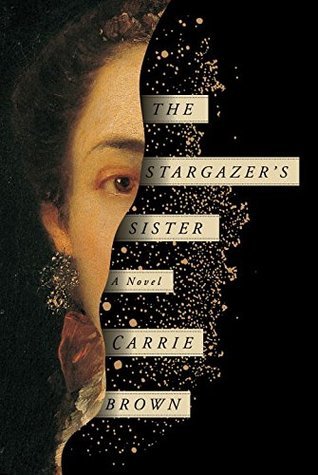
 I love this kind of book. The Stargazer’s Sister is the mostly-true story of Caroline Herschel, the also famous sister of legendary astronomer, William Herschel. Anyone with even a passing interest in astronomy will know his name, and even those without that passing interest are familiar with some of his discoveries. Ever heard of Uranus? Yeah, he found it. No big deal, right? He perfected the design of the telescope allowing humans to visually reach farther into the universe than ever before. William features heavily in this novel, but Lina, as Caroline is better known, is the true star.
A brilliant astronomer in her own right, Lina would go on to discover numerous comets, one of which bears her name. She was the first female scientist to receive a salary, the first woman in England to hold a government position, the first to be awarded a Gold Medal of the Royal Astronomical Society, and a few other firsts. Standing at just 4 foot-3 inches tall, Caroline Herschel was still a total badass, especially considering she had to work extra hard in order to convince people to take her seriously simply for being a woman. Caroline and William remained extremely close throughout their lives, with Caroline originally living with William and working as his assistant. When William married in 1788, Caroline left the home and went out on her own. While some view her as a jealous and bitter woman who felt cast out, I think this is way too simplistic of an outlook. In reality, while it may have stung being forced out of the only home she’d ever known, Caroline took the opportunity to achieve more independence, and this period is when her own accomplishments began to shine. She didn’t wallow. She rose above and kept bettering her own life.
The real question is how does all of this factor into the novel? Brown does take quite a few liberties, but the spirit of Caroline’s story is quite intact. Brown begins with Caroline’s early life, a difficult life with a miserable and uncaring mother from whom William offered her an escape. Under William’s tutelage Caroline thrived, discovering and exploring the depths of her own intellect. She managed every aspect of the household while also juggling her academic duties as William’s assistant. Frankly, if the novel is to be believed, William wouldn’t have achieved near as much without Lina’s tireless efforts to assist him, keeping everything in order so that he could pour all of his time and energy into developing his telescopes.
Brown effortlessly and authentically captures the essence of Lina. She is complex, both aware of her intellectual prowess while also possessing almost crippling doubts about her worth as a woman. She adores and idolizes her brother but is fully aware of and accepting of his faults. At times, I even found Brown’s depictions of Lina’s feelings for William as verging over into the inappropriate category. Somewhat of a savior complex, I presume. The biggest criticism I see from other readers is that it is long and not a lot happens. What does happen materializes slowly. These readers aren’t wrong, but I didn’t find myself being bothered by it. I enjoyed reading this book and was content to follow Lina’s story for a while, even if it meandered through the drudgery of her day to day existence. In the late 1700’s and early 1800’s, women’s lives were not full of adventure. For God’s sake, I picked up a historical fiction book about 18th century astronomers. I didn’t expect them to actually go to space. Lina was a work horse, and she deserved any manner and amount of accolades that eventually came her way. I guarantee you she deserved a lot more than she actually received.
There was one liberty Brown took in introducing us to William and Lina’s lives that I don’t agree with, as it makes no sense to me. Brown presents to us readers that William Herschel and his wife, Mary Baldwin Herschel, were never able to have children and this was a great sorrow for them both. This is purely contrived. In fact, the couple’s son, Sir John Frederick William Herschel was a famed mathematician, astronomer, chemist, inventor and photographer. He was a big fucking deal! Additionally, Lina shared a very deep bond with her nephew that would last beyond her brother’s death. I feel like Brown replaced John with her contrived character of Stanley, who didn’t really add all that much to the story except for his place as a companion for Lina, and she could have just as easily used John and remained more authentic in her representation of this family’s history. In fact, she cuts off his whole bloodline. John would go on to have TWELVE CHILDREN. There are all kinds of William Herschel descendants bopping around this planet today, and Carrie Brown robbed him of a large part of his legacy. Of all the things to take a writer’s license with, I thought this was an odd choice.
Overall, I enjoyed the writing, and I applaud the fact that Carrie Brown gave a wonderful woman from history a real voice. Caroline Herschel is definitely someone to be celebrated.
Published January 19, 2016 by Pantheon. ISBN 9780804197939. 352 pages. Hardcover.

 A Librarian and Her Books
Your review promises much to look forward to, in the book. Thanks.